
Putting Everything in Its Proper Place : Reflections on a First Reading
This is a reflection written immediately after a first reading of the book. A second reading is forthcoming.
A First Encounter with the Book
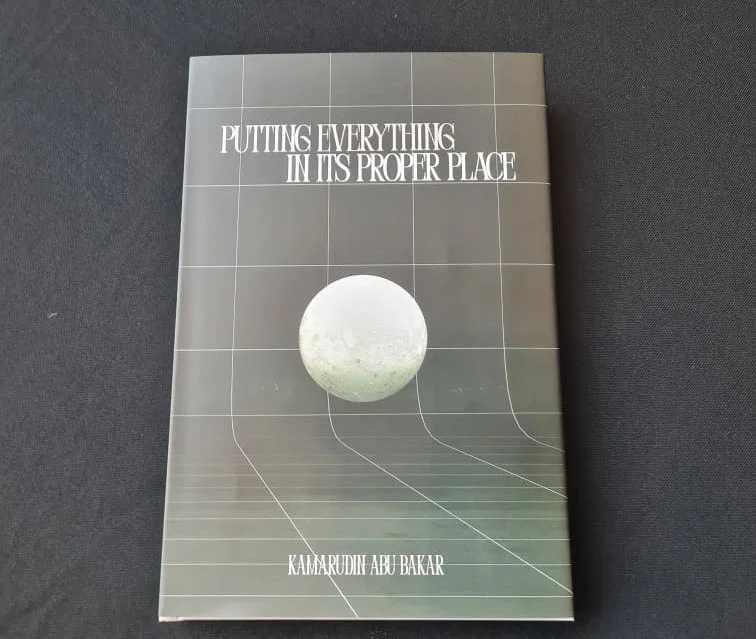
This review was formed immediately after completing a first reading of Putting Everything in Its Proper Place, by Kamarudin bin Abu Bakar (2026). In hindsight, the book may have been read too quickly, and it is clear that it deserves, and will receive, a second, slower reading. What follows, therefore, are my reflections and impressions encountered along the way.
One of the striking features of the book is its tone. At times, it reads less like a conventional exposition and more like advice offered to a friend. While the narrative appears personal, it also functions as guidance: on how to approach ideas, how to read demanding works, and how to situate oneself intellectually and ethically before engaging with them.
Intellectual Journey and the Question of Readiness
The author writes from a distinctive place. He is an accomplished corporate figure and professional who has spent a lifetime reading, thinking, and building a solid intellectual foundation before narrowing his focus to the works of Tan Sri Professor Syed Muhammad Naquib al-Attas. Prior to that focus, he describes having read widely what he terms “perennial” works. This is a journey not everyone has undertaken, nor could easily replicate.
This context matters. Not everyone has read what the author has read; not everyone has the same preparation or stamina. The book acknowledges this frankly, especially when describing how people from many countries travel simply to be in the presence of Tan Sri Syed Muhammad Naquib al-Attas, often awed by him. Yet awe alone does not guarantee understanding.
Here, the author’s observations are particularly valuable. He names the density and difficulty of Al-Attas’s writings without apology. They are heavy, demanding, and not to be taken lightly. They require maturity — intellectual, moral, and spiritual.
“Islam is not for fools.”
This reminder is quoted not to intimidate, but to caution. This is brilliant writing, but brilliance does not mean ease.
At the same time, the author avoids turning difficulty into elitism. He recognises that the entry point is high, and that not everyone is ready at the same time. Awareness and maturity must be cultivated. One must be primed before entering. Going in headlong, without preparation, risks either coming away with nothing or, worse, misunderstanding profoundly.
In that light, the suggestion that Islam and Secularism is a suitable entry point is helpful and practical. It is widely read, well known, and offers grounding before one attempts more demanding works.
Ambiguity, Grey Areas, and Ethical Discomfort
One of the most challenging aspects of the book lies in its treatment of ambiguity and grey areas. This is not a weakness of the work, but a point of tension that invites reflection.
“To recover our balance, we must relearn the art of living with partial knowledge.
Perfection lies not in always being right but in being rightly oriented - in acting sincerely even when the path is not entirely clear. When people once again say “God knows best” with serenity rather than sarcasm, we will have regained something of our spiritual maturity.” (p. 192)
The instinctive mindset many readers bring — “Is this halal or haram?” — is acknowledged. Yet the book seems to suggest that reality does not always resolve itself so neatly. Grey areas exist, and their existence is itself a test: how one deals with ambiguity, restraint, and uncertainty.
Concepts such as avoiding what is doubtful and exercising wara’ naturally come to mind. The author approaches these matters with humility and without judgmentalism, which makes the discussion ethically coherent and grounded in values.
This becomes particularly evident when discussing mu‘amalat, ethics, and modern systems — especially in banking and finance. Certain practices, though problematic, may be tolerated temporarily for reasons of maslahah. They function as a crutch, a tongkat, meant to support movement toward something better.
The discomfort arises when temporary measures become permanent. This is suggested when people (and institutions) grow comfortable with them, reinforce them, and even, in my words, seemingly “seek rent” from them. The implication seems to be that such arrangements are not meant to endure indefinitely. There must be a sincere effort to work toward a way out.
As a legal practitioner who advises people daily about their legal issues, ethical questions arise unavoidably and not all are easily engaged. Victims of crime denied justice, people under investigation, complainants with possibly collateral motives; society presents a kaleidoscope of competing interests, and it is the lawyer’s role to help clients navigate the path in accordance with law. But a good lawyer proactively helps the client avoid pitfalls and educate them too. Thus it resonated with me the author’s discussion on the banking and corporate sectors. I was most interested in his perspective on the field of Islamic finance, of which he was deep into for decades.
“…[I]n a disordered world, we are not asked to bring perfect justice, but to bring what justice we can - in its proper time, to its proper degree, given our knowledge and circumstances.
This was a metaphysical answer to questions that had shadowed me throughout my career : Was it ever acceptable to compromise ethics and morals in pursuit of a greater good? Should I have avoided bank loans altogether? Should I have worked in a bank? Was it right to sell systems that supported Islamic banking when I myself called it a sham? Was my justification - that I was merely providing the tool - good enough? And what, ultimately, is the real answer to the riba conundrum?” (p. 223)
* Please note that this excerpt was of introspective questions the author put to himself and must be read in the surrounding context of his conversation with an erudite Malaysian professor. The point was on “relative justice”, which is different from and should not be conflated with what is understood to be “relativism” in post-modern thought - they are two unrelated things.
These passages invite deeper engagement and rereading. The book is precise and almost scientific in much of its earlier exposition, which makes its apparent acceptance of ambiguity in later sections especially striking.
Encountering Tan Sri Syed Muhammad Naquib al-Attas
The sections introducing the works and influence of Tan Sri Professor Syed Muhammad Naquib al-Attas are among the most illuminating. Though presented narratively, they read as guidance. Personally, I read it like a freshman receives survival skills from a senior (perhaps one who has graduated). The writer provided advice on how to approach Al-Attas’s writings, how to prepare oneself, and how to read with seriousness and humility.
Humility is key. I recall on the turn of 2018, a person I regarded well, considered such work as “terlalu Attas”, a play on words that it is too high above, aloof, perhaps elitist. Another person whom I believe is one of the most well read persons I know, had some kind of mental block that prevented him from opening his mind to such work, all due to what sounded to me like a trifling misunderstanding from bygone times. Maybe some people just project their own struggle to understand.
The author’s own journey from broad intellectual exposure to focused engagement provides context for his story rather than authority. He does not claim mastery on behalf of the reader, but he does caution against superficial engagement.
The reverence surrounding Al-Attas is also addressed. I am also interpolating here : There are people who seek his presence; some regard him as a mujaddid. While the book does not attempt to define how Al-Attas himself views such reverence, it makes clear that proximity alone is not understanding. Commitment and stamina are required to truly read and benefit from the work.
Reading the Book: Structure, Flow, and Experience
The book was not read linearly at first. Like many readers encountering a new work, I began in the middle, specifically with chapters on Islamic banking, out of curiosity and personal interest. Though not a banker and never having been inside the system, these sections proved compelling enough to prompt continuous reading through to the end, completed in a single night.
The following morning, the book was reread from the beginning up to that midpoint (page 82, not quite the middle). Doing so clarified the build-up of his career journey and interactions with characters such as Goh Peng Ooi, and the narrative arc leading into the later discussions.
The author’s accounts of corporate life, early exposure to computing, and professional experience are particularly engaging. Details such as punch cards, delayed error detection, and early computing practices evoke an era unfamiliar to younger readers. Mentions of writing for Computimes in the 1990s resonated deeply with me as an avid reader, and enjoyer of those pull-out sections.
These details stir personal memories: Computimes being mailed overseas by a parent, sections on computer games eagerly anticipated, and the sense of connection such details create across generations.
The book’s layout, font size, headings, and flow, makes it very readable, perhaps too readable. It is easy to read quickly, which risks glossing over weighty points that deserve slowing down. Particularly in the final third, complex ideas are sometimes introduced briefly, when they could merit fuller exposition.
Family, Memory, and Moral Formation
The personal dimensions of the book are among its most touching elements. Stories of family, siblings, hometown, and early life ground the philosophical discussions in lived experience. The return to these figures later in the book creates a sense of continuity.
The discussion of Imam al-Ghazali is especially notable. The author draws connections between al-Ghazali’s teachings and the value systems embedded in his hometown and in Tarim, Hadramawt, which the author visited. These places are presented not merely as locations, but as environments where moral and intellectual traditions are lived and transmitted.
I took the opportunity to reflect on what I learned from my school textbooks about the spread of Islam in the Malay archipelago. It discussed three major theories, based on predominantly India-origin, China-origin, and Arabia-origin theories. I think they were silent on Hadramawt specifically Bani Saadah. Missionaries from Hadramawt (being a distinct region at the southern part of Arabia), especially the Bani Saadah, played an important role in bringing Islam to the Malay Archipelago, a fact reflected in the widespread practice of the Shafii mazhab and Islamic spirituality throughout the region. By contrast, Indian Muslim traders, as highlighted by Snouck Hurgronje, would have brought mostly Hanafi practices, while Chinese Muslim networks, noted by Emanuel Gadinho de Eredia, likely carried a mixed jurisprudential influence. While we should not underestimate the contributions of those who introduced Islam from India or China — traders or otherwise — it seems clear to me that it was the Hadrami missionaries who were doing the heavy lifting in establishing the religious, educational, and cultural foundations that shaped the Malay world and thought.
For this reader, the author’s passages are both relatable and challenging. The transition from concrete, vividly described experiences to the lofty intellectual legacy of Imam al-Ghazali feels abrupt. The connection is there, but following it fully requires familiarity with al-Ghazali’s works that I readily admit I do not yet possess.
Closing Reflections
Putting Everything in Its Proper Place is deeply enjoyable, intellectually stimulating, and ethically serious. It is accessible without being simplistic, personal without being indulgent, and demanding without being alienating.
This first reading has made one thing clear: the book rewards attention, patience, and rereading. It drops weighty ideas lightly — sometimes so lightly that they can be missed if one reads too fast.
A second reading will not be optional. It will be necessary.